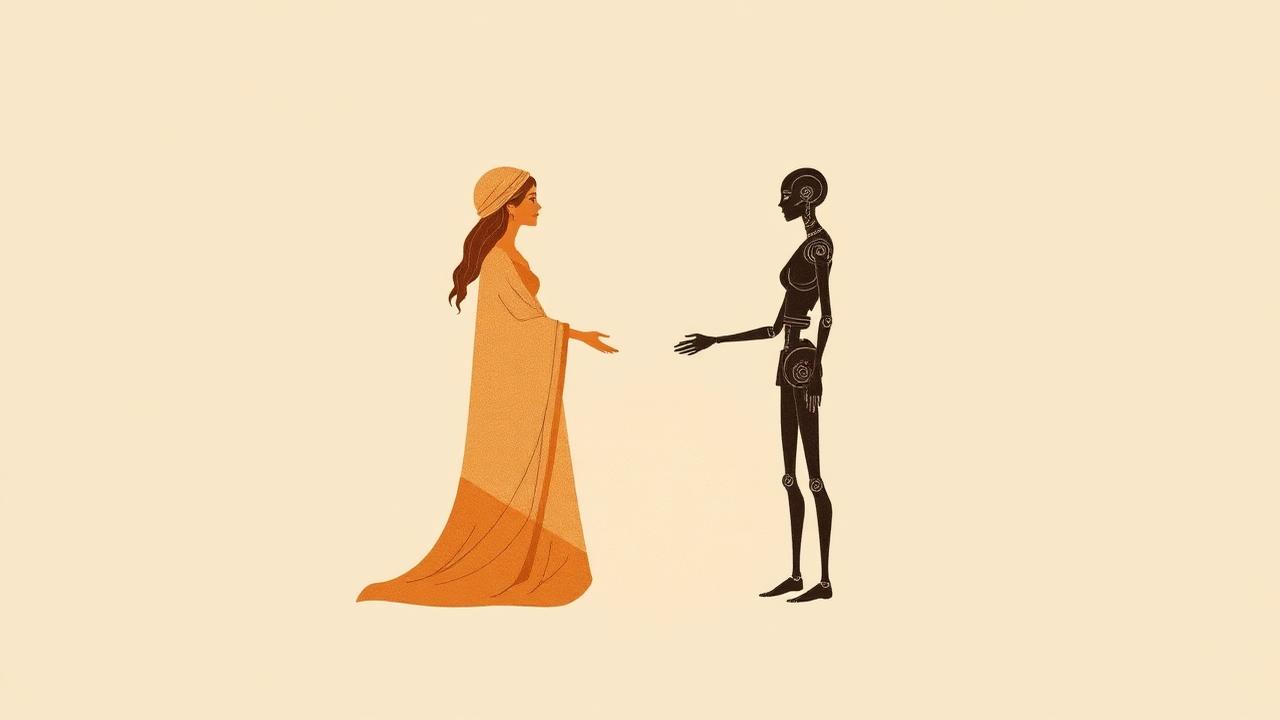
A 3,000-Year-Old Job Just Got an Upgrade
For most of human history, finding a partner was not your job. It was someone else's.
Matchmakers existed in nearly every culture. Greek, Jewish, Chinese, Indian, Persian, West African. The role appeared independently across civilizations because the underlying need was the same. Meeting compatible people is hard, and most people are not in a position to do it well on their own.
For three thousand years or so, the answer was simple. You went to someone who knew you, knew the other people in your community, and could make a thoughtful introduction.
Then for about two decades, we tried something else.
The Detour
Dating apps did not appear because matchmaking was broken. They appeared because matchmaking was expensive.
A good human matchmaker, at the time apps were being built, cost anywhere from a few thousand dollars to half a million depending on the service tier. That was the business reality. One person can only deeply know so many clients at a time. Curation is labor-intensive. The economics of personal attention made the premium service stay premium.
Dating apps offered a different proposition. Free, or nearly free, instant access to thousands of profiles. You could be your own matchmaker. The promise of scale would solve what cost had limited.
It did not work.
What dating apps actually built was not a matchmaker at scale. It was a marketplace. The two are not the same. A matchmaker is paid to make a connection that lasts. A marketplace is paid to keep you transacting. Over time, the two systems optimize for completely different outcomes.
By the time the misalignment became obvious, the category had already shaped a generation of expectations about how people meet. Swipe culture, the gamification of attention, the steady erosion of trust. We forgot what we had given up.
The Quiet Return
Something interesting started happening in the last few years. Premium matchmaking services began growing again, not shrinking. People who could afford it were paying $50,000, $100,000, sometimes more, for the experience of being introduced thoughtfully by a human who actually knew them.
It was not nostalgia. It was a real signal. The matchmaker model works. People who tried both kept choosing matchmaking when they could.
The only problem was the price.
The question we built synch around was simple. What if the matchmaker model could finally be available to everyone?
Where AI Fits
There is a version of AI that replaces humans, and a version that restores something humans used to do. Most of the attention right now is on the first one. The interesting work is happening in the second.
A great matchmaker does three things that a dating app cannot.
They know you deeply, including the parts of you that do not fit neatly into a profile.
They curate with intent, introducing you to people they have specifically thought about as candidates for you.
They care about the outcome, not the activity. They want you to find someone, even though that means losing a client.
A great AI matchmaker can do all three. It can know you through conversation, including the things you would never put on a form. It can introduce you to people with reasoning, with explanations, with intent. And because the business model is built around getting you off the platform into a real relationship, the incentive finally aligns with the user.
What changes with AI is the economic constraint. A human matchmaker can deeply know maybe twenty clients. An AI matchmaker can deeply know millions, each one as completely as the first. The premium that used to cost five figures becomes accessible to anyone.
This is not AI replacing a profession. It is AI letting a profession reach a scale it never could before.
Where AI Surpasses
Saying AI matchmaking matches what humans can do is actually underselling it. In some specific ways, AI matchmaking does the job better than any human matchmaker structurally can.
Scale of search. A human matchmaker at any given moment can hold maybe twenty or thirty active clients in mind. AI matchmaking can search across millions, each one represented with the same depth and specificity. The pool of people you could actually match with becomes orders of magnitude larger, without losing the quality of consideration.
Absence of bias. A human matchmaker carries personal assumptions, often without realizing it. About which kinds of people belong with which other kinds. About what successful pairings look like. About what counts as a strong match. These assumptions can be useful, but they can also limit who gets considered. AI matchmaking does not bring these biases. It builds its understanding from what you have actually said, not what a person has been culturally trained to expect.
No encoded shortcuts. Most human matchmakers operate on heuristics out of necessity. Lawyers with lawyers. Same age range. Same neighborhood. Same religion or education tier. These shortcuts exist because no human can do the deep work for every introduction. AI can. It can hold the actual person in view, not a category they happen to fit, and find compatibility that would never have made it past the heuristic filter.
Consistency. A human matchmaker has bad days, blind spots, fatigue, distractions. Their attention to one client varies with mood, workload, and time. AI is consistent. The depth of attention you receive today is the same as the depth you receive a year from now.
Perfect memory. A human matchmaker remembers what they wrote down, and what stayed memorable. AI remembers everything you have shared, and can connect something you mentioned three weeks ago to a choice you are making now. This kind of continuity is impossible at human scale.
The result is not just a cheaper version of matchmaking. It is matchmaking with structural advantages that traditional matchmaking can never have.
What synch Actually Is
synch is an AI matchmaker and dating coach.
Lily, the AI character at the center of synch, is built to do the matchmaker's job. She learns who you are through real conversation, not questionnaires. She remembers what you have said across weeks and months. She notices when what you say you want differs from what you actually respond to. She introduces you to people with reasoning attached, with compatibility reports that explain why she thinks you would align.
We did not call synch a dating app because it is not one. We did not call it an AI girlfriend or AI companion because it is not that either. It is the third thing. A matchmaker, finally available without the price tag.
This category is going to grow. The next decade of how people meet will look more like the centuries before dating apps than the two decades during them. Curated. Considered. Personal. Just powered by something different.
What It Means for You
If you have spent years on dating apps and wondered why it never felt right, this is part of the answer. You were using a marketplace to do a matchmaker's job, and the two were never built for the same outcome.
The shift is already happening. You can be early to it.
Date, intelligently.
Frequently Asked Questions
What is an AI matchmaker?
How is an AI matchmaker different from a dating app?
How is an AI matchmaker different from a human matchmaker?
Why do AI matchmakers exist now and not earlier?
Meet your AI matchmaker
Start a conversation with Lily and meet someone you would genuinely connect with.
Get Started